
Leadership at Sea: Ammolite Security CEO Cara Wolf Joins the Royal Canadian Navy’s Canadian Leaders at Sea Program
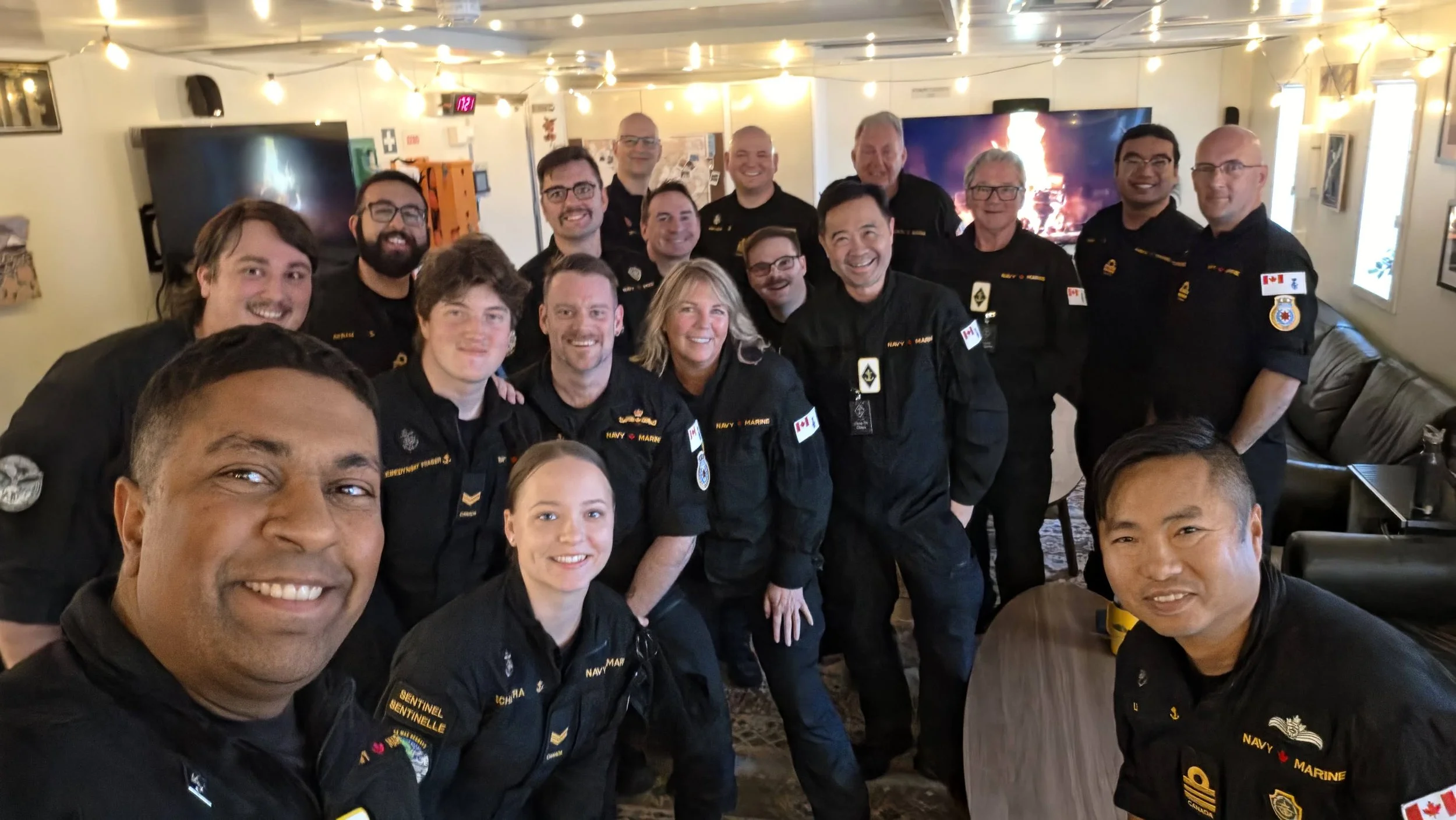
In September 2026, Ammolite Security CEO Cara Wolf had the opportunity to participate in the Canadian Leaders at Sea (CLaS) program aboard HMCS Max Bernays, one of the Royal Canadian Navy’s Arctic and Offshore Patrol Ships.
Invited by the Commander of the Royal Canadian Navy, Cara spent several days sailing aboard HMCS Max Bernays from Prince Rupert to Vancouver.
The CLaS program brings Canadian leaders from different sectors into the Royal Canadian Navy environment to gain a firsthand understanding of its people, capabilities, operations and role in Canada’s defence and security.
Rather than learning about the Navy through presentations or briefings alone, participants join a Ship’s Company at sea and experience elements of naval operations firsthand.
Leadership, Trust and Communication

Cara spent time with members of the Ship’s Company, learned about the ship and its capabilities, observed operations, and participated in activities designed to provide a better understanding of life and leadership at sea.
Coming from an executive and board governance background, she was particularly interested in how leadership, accountability, risk management, communications, and decision-making work in an environment where clarity and execution really matter.
What struck Cara most was the professionalism of the Ship’s Company and the degree of trust required across the ship.
A modern navel vessel is a highly complex operating environment. No single person can possess all of the expertise required to operate it, so effective leadership depends on having highly capable people around you, trusting their expertise, and creating systems that allow information to move quickly and accurately.
That is a direct parallel with modern board and executive leadership.
Cara was also impressed by the Navy’s approach to communication. People are taught structured ways of communicating so that information is given and received in a consistent format. In a fast-moving environment, that reduces ambiguity and enables quicker, better-informed decisions.
“In corporate environments, we often talk about communication, but the Navy demonstrates what happens when communication becomes an operating discipline rather than simply a leadership aspiration. Information needs to be concise, understood, and actionable.”
Lessons from Life at Sea
Spending time on the bridge and seeing how the team operates together was a particular highlight.
Watching information move between people, seeing how responsibilities are clearly understood, and observing how the team maintains situational awareness reinforced something Cara has seen throughout her career:
“Strong leadership is not about one person having all the answers. It is about building capable teams, creating clarity, and ensuring that people have the confidence and authority to perform their roles.”
Cara was also fascinated by the technology aboard HMCS Max Bernays and the integration of people, communications, sensors, and information systems required to operate a modern warship.
The experience reinforced the importance of preparedness, clear accountability, and trusting expertise. Boards face increasingly complex issues involving technology, cybersecurity, AI, geopolitical risk, and critical infrastructure. Directors cannot personally be experts in everything. Their responsibility is to ensure the right expertise is around the table, ask the right questions, and create conditions in which good information reaches decision-makers.

Workforce Recruitment and Education
Sailing with the Navy also gave Cara a firsthand look at its workforce recruitment models.
“Sailing with the Navy as a CLaS guest gave me a firsthand look at their workforce recruitment models. I was particularly interested in how they eliminate barriers to education through fully paid pathways like the Non-Commissioned Member Subsidized Training and Education Plan (NCMSTEP), the gap-year Naval Experience Program (NEP), and their recently expanded 75% tuition reimbursement of the Naval Reserve.”
Cara also came away with an even greater appreciation for the people serving in the Royal Canadian Navy and the technical expertise, judgment, adaptability and teamwork required in today’s naval operations.
Thank You to the Royal Canadian Navy
Cara would like to thank the Royal Canadian Navy for the invitation and the opportunity to participate in Canadian Leaders at Sea.
She would particularly like to recognize Commander Ryan Bell and the entire Ship’s Company of HMCS Max Bernays for welcoming participants aboard and sharing their expertise and experiences so openly.
“The program gave me a much deeper appreciation for the professionalism, capability and people behind the Royal Canadian Navy, and it was a privilege to spend those days at sea with them.”